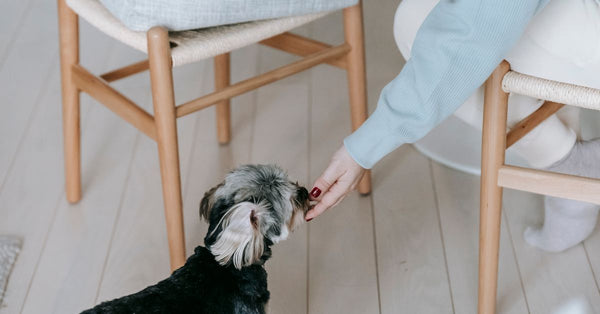
If your older dog has started having accidents indoors, it is natural to wonder whether their joints might be involved. You may also be asking whether a joint supplement could help with the bladder side of things. Lots of owners worry about this, and it deserves a straight answer.
The short answer is no. A joint supplement and a bladder product do different jobs, and a daily joint chew is not designed to support the bladder or urinary system. What can be true is that sore joints and toilet accidents sometimes overlap in daily life, which is why it helps to understand both.
In this article we look at why accidents happen, what to do first, how to make toileting easier for a stiff dog, and where a joint supplement fits. Anything involving the bladder needs your vet, so we will keep coming back to that.
Choosing a joint supplement when bladder health is on your mind
A joint chew and a bladder product do different jobs, so this comparison looks at the joint side only. If your dog has stones or other urinary concerns, you probably want to know exactly what each supplement contains, and the table below sets that out clearly.
MedPaw Hip & Joint Chews Max is our product, and it heads the table alongside five other well-known UK joint supplements.
UK dog joint supplements compared, ingredient by ingredient
| Ingredient | MedPaw Hip & Joint Chews Max | NutraPaw Joint Support | YuMOVE Joint Support PLUS Max | Seraquin Joint | Synoquin EFA | Nutraquin+ |
|---|---|---|---|---|---|---|
| Key joint actives | 6 of 6 | 4 of 6 | 3 of 6 (+1 via mussel) | 2 of 6 | 2 of 6 | 3 of 6 |
| Glucosamine | ✓ | ✓ | ✓ | ✓ | ✓ | ✓ |
| Chondroitin | ✓ | ✗ | Via mussel | ✓ | ✓ | ✓ |
| MSM | ✓ | ✓ | ✗ | ✗ | ✗ | ✗ |
| Green-lipped mussel | ✓ | ✓ | ✓ | ✗ | ✗ | ✗ |
| Hyaluronic acid | ✓ | ✓ | ✓ | ✗ | ✗ | ✗ |
| Boswellia | ✓ | ✗ | ✗ | ✗ | ✗ | ✓ |
| Omega-3 | Mussel, flax | Mussel | Mussel, fish oil | ✗ | Krill oil | ✗ |
| Turmeric | ✗ | ✓ | ✗ | ✓ | ✗ | ✗ |
| Collagen | ✗ | ✓ | ✗ | ✗ | ✗ | ✗ |
| Antioxidants | Vit C, Vit E, zinc | Manganese | Vit C, Vit E, manganese | ✗ | Vit C, zinc | Vit C, zinc |
| Format | Soft chew | Tablet | Tablet | Chewable tablet | Tablet or capsule | Capsule |
| Guarantee | 60 days | 90 days | 6 weeks | Not stated | Not stated | Not stated |
✓ = included, ✗ = not listed. Key joint actives: glucosamine, chondroitin, MSM, green-lipped mussel, hyaluronic acid and Boswellia. Taken from each manufacturer's published information, September 2026.
The top row is the quickest guide. MedPaw lists all six key joint actives: glucosamine, chondroitin, MSM, green-lipped mussel, hyaluronic acid and Boswellia serrata. It is the only one of the six products to do so. NutraPaw scores 4 of 6, YuMOVE and Nutraquin+ 3 of 6, and Seraquin and Synoquin EFA 2 of 6.
For a dog whose owner reads every label, that breadth matters. One daily soft chew supports joints, mobility and comfort from several angles, so you are not stacking extra products. It also adds omega-3 from green-lipped mussel and flax seed, plus vitamins C and E and zinc, made with rapeseed oil and glycerine.
Each product is a complementary feed, so none replaces veterinary care. If you choose MedPaw, there is a 60-day money-back guarantee and Subscribe & Save, and 2 to 3 months of daily use is recommended for the best results.
MedPaw contains green-lipped mussel, which is a shellfish, along with rapeseed oil and flax seed. If your dog has a shellfish allergy, needs a low-fat diet, is pregnant or nursing, or is still a growing puppy, check with your vet before starting any joint supplement.
Explore MedPaw Hip & Joint Chews Max You can read the full ingredient list and feeding guide for the soft chew on the product page.
Why a joint supplement is not a bladder product
A joint supplement such as a daily chew is a complementary feed. Its job is to support joint comfort and mobility alongside veterinary care. It is not a treatment for any condition, and it has no role in managing infections, stones, incontinence or kidney problems.
Urinary supplements, pastes and special diets are a separate category. They are used for different reasons and, in many cases, only after a vet has worked out what is going on. A supplement made for joints is simply not made with the bladder in mind.
So if your worry is toileting, the first step is not a supplement. It is a conversation with your vet.
Why accidents happen in older dogs
Indoor accidents can have more than one cause, and the causes can sit side by side. That is exactly why guessing is unwise.
The urinary side
As dogs age, they may become more prone to urinary and kidney conditions, and some breeds more than others. Infections and other bladder problems can be truly uncomfortable. Affected dogs may lose their appetite or struggle to sleep.
The cause might be an infection, stones, a hormonal issue, kidney disease or something else entirely. Each one needs different handling, and only a vet can tell them apart.
The mobility side
This is the everyday overlap. A dog with stiff or sore joints may find it harder to get up quickly, manage steps, squat or reach the garden in time. Dogs with sore hips or backs can also take longer to settle into a comfortable toileting posture.
Some owners therefore see accidents that are really about getting there rather than about the bladder itself. That is a common-sense observation, not a diagnosis. Your dog could have a mobility issue, a urinary issue, or both at once.
Why only a vet can sort it out
From the living room floor, the two look much the same. A puddle by the back door could mean a dog who could not get up in time, or a dog with a urinary problem. Your vet can examine your dog, test a urine sample if needed, and check the joints too.
What to do first if your dog is having accidents
Before you buy anything, take these steps. They are simple, and they give your vet useful information.
- Book a vet check. Mention when the accidents happen, such as while asleep, after exercise or when out on a walk.
- Keep a simple diary for a week or so. Note how often your dog drinks, urinates and has accidents, and whether accidents follow long rests or exertion.
- Take a fresh urine sample if asked. Vets often request one. A clean, shallow container usually works, and your practice can advise on the best method.
- Do not restrict water unless your vet tells you to.
The diary is more useful than it sounds. Patterns such as accidents only after a long sleep, or only on slippery floors, give your vet real clues about where to look.
Making toileting easier for a dog with stiff joints
Whatever the final diagnosis, a few changes at home can make life more comfortable for a dog who finds moving around difficult. None of these replace veterinary advice, but they are kind and practical.
- Offer more frequent, shorter trips outside, especially first thing, after meals and last thing at night.
- Put non-slip rugs or mats on smooth floors so your dog can get up with confidence.
- Use a ramp or a few steps with good grip where there is a step to the garden.
- Place the bed on the ground floor, close to the back door, if stairs are a struggle.
- Keep your dog at a healthy weight. Extra weight adds strain to joints, and your vet can advise on a target.
- Keep up gentle, regular, low-impact exercise, as advised by your vet.
Small changes can make a real difference to a dog who is trying their best. Many dogs seem more relaxed once the route to the garden feels easy and safe.
A note on diet and urinary products
You will find plenty of urinary supplements, tablets, pastes, powders and special foods online. They can look tempting when you are worried, but they are not something to choose on your own.
Products like these tend to follow a vet's diagnosis. If a vet has diagnosed a urinary problem, or considers a dog at risk, extra help may well be needed. The wrong product for the wrong problem can delay proper care.
Diet is the same. Specialised diets are available, and some are prescription or vet-guided. The right one depends on the diagnosis. Please do not change your dog's food for urinary reasons without talking to your vet first.
Where a joint supplement fits
If your vet has looked at your dog and joint comfort is part of the picture, a joint supplement can be one part of the plan. Think of it as a complementary feed that supports joint comfort and mobility, given daily alongside veterinary care and sensible changes at home.
MedPaw Hip & Joint Chews Max is a daily soft chew designed to support your dog's joints. It is not designed or intended to support the bladder or urinary system, so if you are worried about your dog's toileting, please speak to your vet first.
What is in MedPaw Hip & Joint Chews Max
- Key joint actives: glucosamine, chondroitin, MSM, green-lipped mussel, hyaluronic acid and Boswellia serrata.
- Also contains: omega-3 from green-lipped mussel and flax seed, vitamins C and E, and zinc.
- Made with rapeseed oil and glycerine.
How to give it
The feeding guide is 1 chew a day up to 4kg, 2 chews for 5-17kg, and 2-3 chews for 18kg and over. The amount is doubled for the first three weeks. Joint supplements are meant for steady daily use, so we recommend 2-3 months of daily use rather than expecting a quick change.
There is a 60-day money-back guarantee, and Subscribe & Save is available if you would like regular deliveries.
Tell your vet what your dog is taking
Mention any supplement to your vet, especially if your dog has a urinary or kidney diagnosis, a prescription diet or ongoing medication. Your vet knows your dog's full history and can say whether a joint chew suits them. Please do not expect any joint supplement to change toileting habits. If accidents continue, go back to your vet.
Comparing labels fairly
Other joint supplements come as tablets, capsules or chewable tablets, and ingredient lists differ. For example, NutraPaw Joint Support is a tablet that lists glucosamine, MSM, green-lipped mussel, hyaluronic acid, turmeric and collagen, but not chondroitin or Boswellia. Nutraquin+ is a capsule that lists glucosamine, chondroitin and Boswellia, plus vitamin C and zinc, but not MSM or green-lipped mussel.
Neither is better or worse in general. They are simply different formulas. Read the label, check what a product is actually for, and ask your vet before combining several supplements.
When to see a vet
Any change in toileting is worth a call to your practice. Some signs are more pressing than others, and this guide shows roughly how quickly to act.
How quickly to act on toileting changes
Book a vet appointment
Occasional indoor accidents, a dog who is slower to get up or reluctant on steps, or a change in toileting habits you have noticed over a few days.
Contact your vet promptly
More frequent or smaller amounts of urine, much more drinking, leaking whilst asleep, blood or cloudy urine, a strong smell, excessive licking, discomfort when toileting, or loss of appetite.
Same-day or out-of-hours vet
Straining to pass urine with little or none produced, a swollen or painful tummy, or vomiting, collapse or marked lethargy alongside urinary signs.
Contact your vet promptly if your dog
- is passing urine more often than usual, or in small amounts
- is drinking noticeably more than normal
- is leaking urine, especially while asleep or resting
- starts having indoor accidents after being reliably house-trained
- has blood in the urine, or urine that looks cloudy or smells strongly
- licks the genital area excessively
- seems uncomfortable when toileting, or cries or whimpers
- has lost their appetite, is sleeping poorly or seems unusually quiet
- is limping, reluctant to move or showing signs of pain, as well as any toileting change
Treat as an emergency if your dog
- is straining to pass urine but producing little or none
- has a swollen or painful tummy
- is vomiting, collapsing or very lethargic alongside urinary signs
Not being able to pass urine needs urgent attention. Please do not wait and see. Ring your vet or out-of-hours service straight away.
The bottom line for worried owners
Joint comfort and bladder health are two separate topics that happen to meet in the same worried moment, usually on the kitchen floor. A joint supplement may support your dog's joints, but it is not a bladder product, and it should never stand in for finding out why your dog is having trouble.
Start with your vet, keep a simple diary, make the route to the garden as easy as you can, and add joint support only as one part of the wider plan. A quick conversation with your vet can save you both a lot of worry.
Can I give a joint supplement to a dog with bladder stones?
There is no simple yes or no, because it depends on the type of stone, your dog's diet and any medicine they are on. Your vet knows those details, so please take the supplement label along before you start. A joint chew is a complementary feed for joint comfort and mobility, and it is not part of any bladder stone management.
Will a joint supplement help with bladder stones?
No. A joint supplement is made to support joints and mobility, and it is not designed to support the bladder or urinary system. If you suspect stones, or your dog is straining, passing blood or having accidents, speak to your vet promptly, as straining with little or no urine needs urgent attention.
What should I check on a joint supplement label for a dog on a restricted diet?
Look at the protein and flavour source, any fat or oil, shellfish or fish content, added minerals and the other ingredients such as binders and sweeteners. For example, MedPaw Hip & Joint Chews Max contains green-lipped mussel, omega-3 from flax seed, rapeseed oil, glycerine, zinc and vitamins C and E. Show your vet the full label, as they can say whether anything clashes with your dog's prescribed diet.
How should I introduce a new joint chew to a dog with a sensitive or restricted diet?
Ask your vet first, and bring up a gradual start if your dog has a health condition. The MedPaw label amount is doubled for the first three weeks, so a 20kg dog would have 4 to 6 chews a day at first, then 2 to 3 chews. Your vet may want to adjust that approach for your dog, so please do not change a prescribed diet or medicine yourself.
How long does a tub of MedPaw chews last for a 20kg dog?
A tub holds 60 chews. At 20kg the label says 2 to 3 chews a day, doubled for the first three weeks, so a tub lasts roughly 10 to 15 days at the start. After that it lasts about 20 to 30 days. The label recommends 2 to 3 months of daily use for optimal results.
How do MedPaw chews compare with other UK joint supplements for a dog with health needs?
The formulas differ, so compare labels rather than looking for one best choice. MedPaw is a soft chew with glucosamine, chondroitin, MSM, green-lipped mussel, hyaluronic acid and Boswellia. Seraquin Joint is a chewable tablet with glucosamine, chondroitin and turmeric, and Nutraquin+ is a capsule with glucosamine, chondroitin and Boswellia, so they contain fewer ingredients. Some owners may prefer a simpler list, and your vet can help you weigh that up.