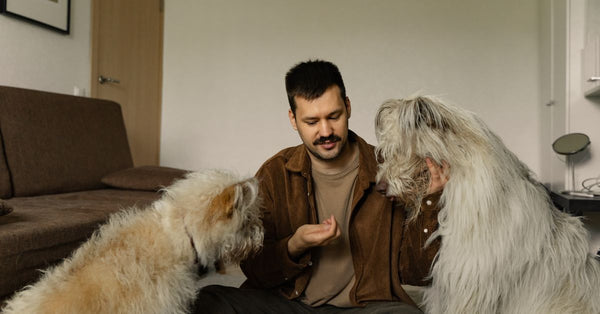
When a dog who used to leap onto the sofa suddenly stops, it is easy to read it as stubbornness, or as a sign they are simply getting older. Often it is neither. A dog who stops doing something they once did happily usually has a reason, and that reason is very often discomfort.
Dogs are good at hiding pain. By the time yours hesitates at the car boot or waits at the bottom of the stairs, they may have been feeling sore for a while. A dog who walks fine but won't jump is a very common pattern, so no limping does not always mean no discomfort.
This guide covers why dogs stop jumping, what to do first, how to make home life easier, and where a joint supplement fits as part of a wider plan. We also set out clearly when to call your vet.
What to look for in a supplement when your dog won't jump
A dog who stops jumping is telling you something, and once your vet has examined them, a supplement can be one part of the plan to support their comfort and mobility. The ingredient list is where products differ most, so that is where we start.
The table below compares MedPaw Hip & Joint Chews Max, our own product, with five other well-known UK joint supplements. It opens with a score for how many of six key joint actives each one lists.
MedPaw is the only one of the six with all six key joint actives
| Ingredient | MedPaw Hip & Joint Chews Max | NutraPaw Joint Support | YuMOVE Joint Support PLUS Max | Seraquin Joint | Synoquin EFA | Nutraquin+ |
|---|---|---|---|---|---|---|
| Key joint actives | 6 of 6 | 4 of 6 | 3 of 6 (+1 via mussel) | 2 of 6 | 2 of 6 | 3 of 6 |
| Glucosamine | ✓ | ✓ | ✓ | ✓ | ✓ | ✓ |
| Chondroitin | ✓ | ✗ | Via mussel | ✓ | ✓ | ✓ |
| MSM | ✓ | ✓ | ✗ | ✗ | ✗ | ✗ |
| Green-lipped mussel | ✓ | ✓ | ✓ | ✗ | ✗ | ✗ |
| Hyaluronic acid | ✓ | ✓ | ✓ | ✗ | ✗ | ✗ |
| Boswellia | ✓ | ✗ | ✗ | ✗ | ✗ | ✓ |
| Omega-3 | Mussel, flax | Mussel | Mussel, fish oil | ✗ | Krill oil | ✗ |
| Turmeric | ✗ | ✓ | ✗ | ✓ | ✗ | ✗ |
| Collagen | ✗ | ✓ | ✗ | ✗ | ✗ | ✗ |
| Antioxidants | Vit C, Vit E, zinc | Manganese | Vit C, Vit E, manganese | ✗ | Vit C, zinc | Vit C, zinc |
| Format | Soft chew | Tablet | Tablet | Chewable tablet | Tablet or capsule | Capsule |
| Guarantee | 60 days | 90 days | 6 weeks | Not stated | Not stated | Not stated |
✓ = included, ✗ = not listed. Key joint actives: glucosamine, chondroitin, MSM, green-lipped mussel, hyaluronic acid and Boswellia. Taken from each manufacturer's published information, September 2026.
Jumping puts a lot of load through the hips, knees and spine, so it makes sense to look for a formula that supports joints from several angles. MedPaw is the only one of the six with all six key actives: glucosamine, chondroitin, MSM, green-lipped mussel, hyaluronic acid and Boswellia serrata. The others list between two and four.
The same row shows where the gaps are. NutraPaw has no chondroitin or Boswellia, YuMOVE has no MSM or Boswellia, and Seraquin and Synoquin EFA have no MSM, green-lipped mussel or hyaluronic acid. MedPaw also adds omega-3, vitamins C and E and zinc.
MedPaw is a daily soft chew, which many dogs take like a treat. Joint support works best when given steadily, so we suggest 2-3 months of daily use for optimal results. There is a 60-day money-back guarantee, and Subscribe & Save if you would like it to arrive regularly.
Explore MedPaw Hip & Joint Chews Max If your dog has been checked over by your vet, this is the chew we would suggest to support their comfort and confidence.
Why a dog who stops jumping deserves a closer look
Jumping is a high-impact movement. It asks a lot of the hips, knees, shoulders and spine, so a dog with sore joints often learns to avoid it before they show any other sign. That is why reluctance to jump can be the first clue you get.
Age is not the only factor either. Joint trouble can begin at any age, especially in breeds that are predisposed to it or after an injury. A six-year-old with achy joints is not unusual, so try not to put it down to "just getting on a bit".
Several different problems can cause the same behaviour, which is why guessing is risky. Only your vet can work out which one is involved.
Common reasons a dog stops jumping
The list below is not for self-diagnosis. It shows how wide the range is, and why a proper examination matters.
Possible reasons for jumping reluctance, and who tends to be affected
| Possible cause | What it can look like | Often discussed in |
|---|---|---|
| Arthritis and osteoarthritis | Stiffness, slower to rise, avoiding impact | Middle-aged and senior dogs |
| Hip dysplasia | Difficulty with stairs, bunny-hopping, reluctance to jump | Larger breeds, though any dog can be affected |
| Spinal problems, including IVDD | Back pain, hunched posture, wobbliness | Long-backed breeds such as Dachshunds, Corgis and Basset Hounds |
| Knee problems | Skipping steps, holding a back leg up | Small breeds in particular |
| Cruciate ligament damage | Painful or impossible jumping, lameness | Dogs of many sizes |
| Strains and sprains | Sudden reluctance after exercise or an awkward landing | Active dogs of any age |
| Tick-borne illness | Joint pain, tiredness, being generally unwell | Dogs exposed to ticks on UK walks |
| A bad experience | Avoiding jumps after a fall or fright | Any dog, but pain should be ruled out first |
| Neuromuscular conditions | Weakness and fatigue | Uncommon, though some breeds may be more prone |
For guidance only, not a diagnosis.
Low energy can also play a part. Illness, infection or an unsuitable diet can leave a dog without the get-up-and-go to jump, which is another reason to involve your vet rather than assume it is joints.
Step one: book a vet appointment
Before relying on any supplement, get the cause looked at. A vet can examine the joints and spine, watch how your dog moves, and may suggest X-rays or other tests. Spinal problems in particular can need prompt attention.
While you wait for the appointment, stop encouraging jumps. Lift your dog into the car or onto furniture, supporting both the front and back end. Avoid games that involve leaping, such as catching a ball in mid-air, and keep walks gentle and on the lead if your dog seems sore.
What to note down for your vet
Your observations are very useful. Try to jot down:
- When the reluctance started, and whether it was sudden or gradual
- Which jumps are hardest: up, down, the car, the stairs
- Any limping, stiffness after rest, or difficulty getting up
- Licking or chewing at a particular joint
- Changes in mood, appetite or willingness to play
A short phone video of your dog moving at home is something many vets find really helpful, because dogs often behave differently in a busy consulting room.
What your vet may suggest
Depending on the diagnosis, the plan might include pain relief medication prescribed for your individual dog, weight management, physiotherapy or hydrotherapy, or in some cases surgery. If there is an underlying illness, such as a tick-borne disease, that will need its own care. Your vet may also suggest a joint supplement to support ongoing joint health alongside everything else.
Please never give your dog human painkillers or leftover medication without veterinary advice.
Making life easier at home
Small changes can make a real difference to how comfortable your dog feels day to day, and most cost very little.
- Ramps or pet stairs for the car, sofa and bed, so your dog does not have to jump at all
- Lower, supportive beds that are easy to step into and out of
- Non-slip rugs or mats on slippery floors, which help a dog with stiff joints feel steadier
- Raised bowls if bending seems awkward, though check with your vet first
Keep moving, sensibly
Regular, gentle exercise generally suits sore or stiff joints better than the occasional long, boisterous outing. Little and often, on a consistent routine, is a good rule. Short walks and light play keep muscles working, and those muscles help support the joints.
Watch the waistline
If your dog is carrying extra weight, bringing it down can make a real difference to joint comfort, because every extra bit of weight is more load on the joints. Ask your vet for a target weight and a feeding plan that works.
Ask about physiotherapy
Hydrotherapy and guided exercises to strengthen the muscles that support the joints are options your vet may mention. Many dogs enjoy them more than owners expect.
Where a joint supplement fits
A joint supplement is a complementary feed. It is there to support everyday joint health and mobility as part of a wider plan. It does not replace a diagnosis, and it should never delay a vet visit. Think of it as one part of the picture, alongside veterinary advice, weight management, sensible exercise and home adjustments.
Glucosamine and chondroitin are the ingredients most often discussed in connection with supporting a dog's joints, but the full ingredient list and the format both matter when you choose.
What is in MedPaw Hip & Joint Chews Max
MedPaw Hip & Joint Chews Max is a daily soft chew, a complementary feed for dogs. The key joint ingredients are:
- Glucosamine
- Chondroitin
- MSM
- Green-lipped mussel
- Hyaluronic acid
- Boswellia serrata
It also contains omega-3 from green-lipped mussel and flax seed, vitamins C and E, and zinc. It is made with rapeseed oil and glycerine.
How much to give
The feeding guide is 1 chew a day for dogs up to 4kg, 2 chews for 5 to 17kg, and 2 to 3 chews for dogs of 18kg and over. The amount is doubled for the first three weeks. Joint supplements are given gradually over time, so we recommend 2 to 3 months of daily use before you judge how your dog is getting on. There is a 60-day money-back guarantee, and Subscribe & Save is available if you would like it delivered regularly.
Choosing between supplements
There are several well-known options, and the best one is the one your dog will actually take every day. Compare them on what the label lists, not just the name. Based on manufacturers' published information from September 2026:
- NutraPaw Joint Support is a tablet containing glucosamine, MSM, green-lipped mussel, hyaluronic acid, turmeric and collagen. It does not list chondroitin or Boswellia.
- YuMOVE Joint Support PLUS Max is a tablet containing glucosamine, green-lipped mussel, hyaluronic acid and fish oil, with chondroitin only via the mussel. It does not list MSM, Boswellia, turmeric or collagen.
- Seraquin Joint is a chewable tablet with glucosamine, chondroitin and turmeric.
- Synoquin EFA comes as a tablet or capsule and contains glucosamine, chondroitin and krill oil.
- Nutraquin+ is a capsule containing glucosamine, chondroitin and Boswellia.
Every dog is different, and each of these suits different dogs and preferences. A few practical tips apply whichever you pick:
- Check the ingredient list and the feeding guide for your dog's weight
- Think about format. Some dogs take a soft chew happily, whilst others manage tablets or capsules hidden in food
- Plan for consistency, because supplements are given daily over weeks and months
- Check for any fish or shellfish sensitivity, as some products contain mussel, fish oil or krill
- Tell your vet about any supplement your dog takes, especially before surgery or if your dog is on prescribed medication
Setting realistic expectations
Your dog may never jump quite the way they did as a youngster, and that is all right. The aim is comfortable mobility and a good quality of life, not a return to puppy-style leaps.
Many dogs with well-managed joint problems live happily for years using ramps and steps instead of jumping. If your dog can potter about, enjoy their walks and settle comfortably afterwards, that is a very good outcome.
When to call the vet
Any change in how your dog jumps is worth a conversation with your vet. Some signs need faster action than others, and the guide below shows how to tell them apart.
How quickly to act on what you are seeing
Early or gradual changes
Hesitating before jumps, stopping jumping altogether, stiffness after rest, slowness to get up, or struggling with stairs and the car. Make a routine appointment.
Signs of ongoing discomfort
Licking or chewing at a joint, less interest in walks or play, or becoming quieter or more irritable. Arrange a visit promptly and do not wait for it to pass.
Same-day veterinary attention
Sudden inability to jump, walk or stand, crying out in pain, a hunched or arched back, wobbliness or dragging back legs, not putting weight on a leg, loss of bladder or bowel control, a hot or swollen joint, or fever and illness after a tick bite.
Back pain or any loss of coordination should always be treated as urgent. If your practice is closed and your dog is distressed, contact an emergency vet.
A dog who stops jumping is telling you something. Listen early, get the cause checked, make life a little easier at home, and add a supplement as a supporting part of the plan if your vet agrees. Your dog will thank you for it in their own way.
Why has my dog suddenly stopped jumping onto the sofa or into the car?
A dog who stops jumping is often avoiding discomfort, because jumping puts a lot of load on the hips, knees, shoulders and spine. It can also follow a fall, a strain or a fright. If the change is sudden, or your dog is crying out, hunched or not putting weight on a leg, please see your vet the same day rather than waiting.
Can I give my dog a joint supplement before seeing the vet?
It is best to get the cause checked first, because several different problems can lead to the same behaviour and only your vet can tell which one is involved. A joint supplement is a complementary feed that supports everyday joint health and mobility as part of a wider plan. It should never delay a vet visit or stand in for veterinary advice or treatment.
How many MedPaw Hip & Joint Chews Max does a 20kg dog need each day?
The printed label says 2 to 3 chews a day for dogs of 18kg and over, and the amount is doubled for the first three weeks. A tub holds 60 chews, so your dog's daily number decides how long it lasts. Your vet can help you settle on the right amount within the label range for your dog.
How long before I might notice a difference in how my dog moves?
Joint supplements are given gradually over time, so we recommend 2 to 3 months of daily use before judging how your dog is getting on. Look for small everyday signs, such as how willingly your dog settles, rises and potters about on walks. Your dog may never jump quite as they did as a youngster, and the aim is comfortable mobility. If you are worried at any point, speak to your vet.
Does it matter whether a joint supplement is a chew, a tablet or a capsule?
The best supplement is the one your dog will take every day, so format matters. MedPaw Hip & Joint Chews Max is a soft chew, whilst NutraPaw and YuMOVE are tablets, Seraquin is a chewable tablet, Synoquin EFA comes as a tablet or capsule and Nutraquin+ is a capsule. Also compare the ingredient lists, as the declared actives differ between products.
Should I avoid a joint supplement if my dog has a fish or shellfish sensitivity?
Check the label carefully and speak to your vet first. Some joint supplements contain green-lipped mussel, fish oil or krill, and MedPaw Hip & Joint Chews Max contains green-lipped mussel. Tell your vet about any supplement your dog takes, especially before surgery or if your dog is on prescribed medication.